

Deeper Dive: Our Top Tested Picks
EDITORS’ NOTE
April 17, 2026: With this update, we added the TP-Link Archer GE650 as our top pick, replacing the Asus RT-BE96U. We also removed the discontinued Reyee E6 AX6000. The rest of our picks have been vetted for currency and availability. We currently have one router, from Asus, in PC Labs for evaluation.
SCORE
4.0
Excellent
What Our Ratings Mean
- 5.0 – Exemplary: Near perfection, ground-breaking
- 4.5 – Outstanding: Best in class, acts as a benchmark for measuring competitors
- 4.0 – Excellent: A performance, feature, or value leader in its class, with few shortfalls
- 3.5 – Good: Does what the product should do, and does so better than many competitors
- 3.0 – Average: Does what the product should do, and sits in the middle of the pack
- 2.5 – Fair: We have some reservations, buy with caution
- 2.0 – Subpar: We do not recommend, buy with extreme caution
- 1.5 – Poor: Do not buy this product
- 1.0 – Dismal: Don’t even think about buying this product
Read Our
Editorial Mission Statement
and
Testing Methodologies.
Pros & Cons
-
Reasonably priced
-
Superb throughput performance
-
Gamer-friendly features
-
Lots of multi-gig networking ports
-
6GHz transmissions
-
Some HomeShield features cost extra
-
Short 6GHz range
The Bottom Line
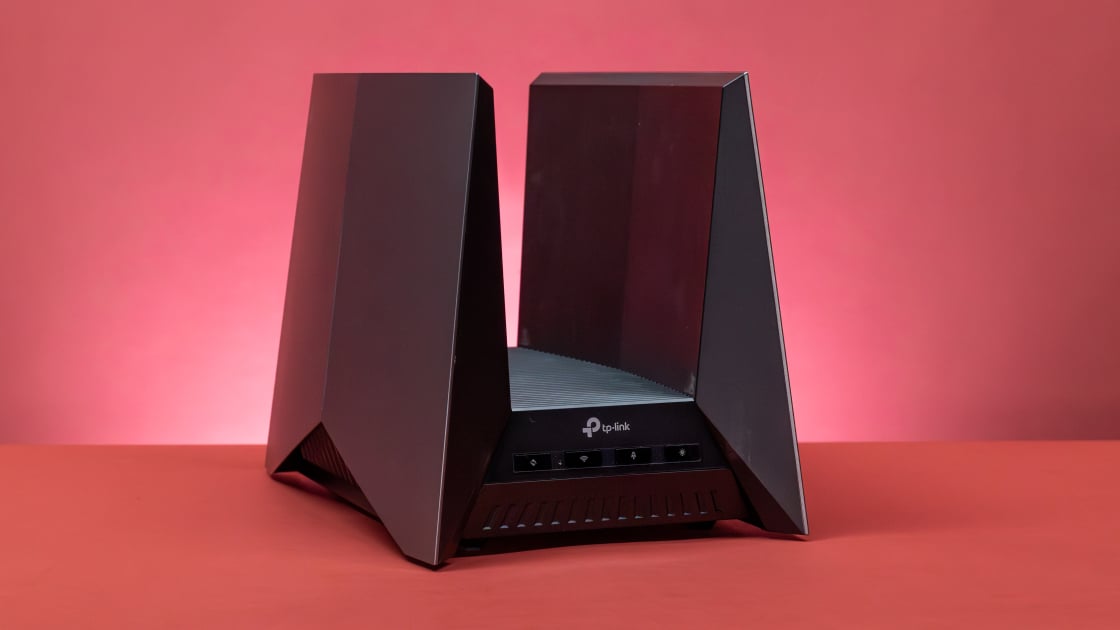
The TP-Link GE650 is a reasonably priced Wi-Fi 7 router designed with gamers in mind. It sports a cool look, delivers speedy throughput performance, and is packed with high-speed networking ports.
Why We Picked It
The TP-Link GE650 is a reasonably priced Wi-Fi 7 router designed with gamers in mind. It sports a cool look, delivers speedy throughput performance, and is packed with high-speed networking ports. Gamer-centric features include optimized acceleration settings and a dedicated game control panel. Plus, many gamers will thrill to the edgy design: It doesn’t look like a typical router. Instead, it has an upside-down V shape that, according to TP-Link, is inspired by a volcano.
Who It’s For
Gamers who want the latest and greatest: The GE650 supports the latest Wi-Fi 7 technologies, including 320MHz channel bandwidth, 4K QAM, direct-to-client beamforming, MU-MIMO data streaming, Multi-Link Operation (MLO), and orthogonal frequency-division multiple access (OFDMA) transmissions.
Gamers who already own a TP-Link router: The GE650 is EasyMesh compatible and can be deployed as a main router or node in a mesh network along with other TP-Link EasyMesh devices.
Specs
Wireless Specification
802.11be
Wi-Fi Speed (Total Rated Throughput)
BE11000
Number of Wired LAN Ports (Excluding WAN Port)
4
Number of USB ports
2
Number of Antennas
4
Number of Bands
3
Wireless Networking Security
WPA2, WPA3
Wireless Parental Controls
Read our full TP-Link Archer GE650 BE11000 Tri-Band Wi-Fi 7 Gaming Router Review
(Credit: Asus)
(Credit: Asus)
SCORE
4.0
Excellent
What Our Ratings Mean
- 5.0 – Exemplary: Near perfection, ground-breaking
- 4.5 – Outstanding: Best in class, acts as a benchmark for measuring competitors
- 4.0 – Excellent: A performance, feature, or value leader in its class, with few shortfalls
- 3.5 – Good: Does what the product should do, and does so better than many competitors
- 3.0 – Average: Does what the product should do, and sits in the middle of the pack
- 2.5 – Fair: We have some reservations, buy with caution
- 2.0 – Subpar: We do not recommend, buy with extreme caution
- 1.5 – Poor: Do not buy this product
- 1.0 – Dismal: Don’t even think about buying this product
Read Our
Editorial Mission Statement
and
Testing Methodologies.
Pros & Cons
-
Wi-Fi 7 with 320MHz channel bandwidth
-
10GbE port, plus several more multi-gig ports
-
Blazing throughput performance
-
Gamer-friendly network customization
-
Network security and parental controls
The Bottom Line
The Asus ROG Rapture GT-BE98 Pro uses top-shelf components, the latest Wi-Fi 7 technologies, and a host of gamer-friendly features to deliver the fastest 6GHz performance we’ve seen to date.
Why We Picked It
The Asus ROG Rapture GT-BE98 Pro combines top-shelf components, the latest Wi-Fi 7 technologies, and a host of gamer-friendly features to deliver the fastest 6GHz performance we’ve seen to date. If your gaming PC is in the same room as your router, the GT-BE98 Pro will be an excellent choice no matter your connection type. Prefer wired? Use the dedicated 10GbE game port. Wireless? We measured speeds in excess of 3,000Mbps via a 6GHz connection. However, note that 6GHz signal strength will likely drop significantly as you move further away from the router, a drawback that all Wi-Fi 7 and Wi-Fi 6E routers share.
Who It’s For
Cutting-edge gaming enthusiasts: The Rapture GT-BE98 Pro is best for gamers who want to future-proof their networks and have the budget to do so. It’s now cheaper than its original $800 MSRP, but it’s still a tough sell for everyone else. If you’d like 6GHz data transmissions but don’t want to spend a bundle for a Wi-Fi 7 router, consider a Wi-Fi 6E router instead.
People who game on Ethernet-connected PCs or consoles: With a 10GbE port, plus several more multi-gig ports, the GE-BE98 Pro has all your wired Ethernet needs covered.
Specs
Wireless Specification
802.11be
Wi-Fi Speed (Total Rated Throughput)
BE30000
Number of Wired LAN Ports (Excluding WAN Port)
6
Number of USB ports
2
Number of Antennas
8
Number of Bands
4
Wireless Networking Security
WPA2, WPA3
Wireless Parental Controls
Read our full Asus ROG Rapture GT-BE98 Pro Review
SCORE
4.5
Outstanding
What Our Ratings Mean
- 5.0 – Exemplary: Near perfection, ground-breaking
- 4.5 – Outstanding: Best in class, acts as a benchmark for measuring competitors
- 4.0 – Excellent: A performance, feature, or value leader in its class, with few shortfalls
- 3.5 – Good: Does what the product should do, and does so better than many competitors
- 3.0 – Average: Does what the product should do, and sits in the middle of the pack
- 2.5 – Fair: We have some reservations, buy with caution
- 2.0 – Subpar: We do not recommend, buy with extreme caution
- 1.5 – Poor: Do not buy this product
- 1.0 – Dismal: Don’t even think about buying this product
Read Our
Editorial Mission Statement
and
Testing Methodologies.
Pros & Cons
-
Multi-gig WAN with strong broadcast signal
-
Sleek design
-
Speedy throughput performance
-
Lots of game-friendly features
-
Included anti-malware and parental control software
The Bottom Line
Asus’ ROG Rapture GT6 is a sleek-looking, two-piece mesh system designed with gamers in mind. It combines game-enhancing settings, fast throughput, strong signal performance, and free Trend Micro network security software in a package that’s a snap to set up and manage.
Why We Picked It
The Asus ROG Rapture GT6 is one of the few mesh systems we’ve seen designed with gamers in mind. The Rapture isn’t cheap, but its superior performance, robust gaming features, and anti-malware tools make it worth every cent. Game-centric settings include a mobile game mode and QoS settings that provide extra bandwidth for online play. Meanwhile, a Game Radar diagnostic utility helps you identify the connection quality of servers for specific games. The GT6 easily earns our Editors’ Choice award for gamer-centric Wi-Fi 6 mesh systems.
Who It’s For
Gamers who appreciate RGB effects: With a cool-looking design and Aura RGB lighting effects, the Rapture GT6 is obviously meant for gamers.
Gamers who want a strong signal everywhere: If you’ve been searching for a whole-home Wi-Fi 6 mesh system that offers many of the features of a dedicated gaming router, Asus has your number.
Specs
Wireless Specification
802.11ax
Wi-Fi Speed (Total Rated Throughput)
AX10000
Number of Wired LAN Ports (Excluding WAN Port)
3
Number of USB ports
1
Number of Antennas
9
Number of Bands
3
Wireless Networking Security
WPA2, WPA3
Wireless Parental Controls
Read our full Asus ROG Rapture GT6 Wi-Fi 6 Gaming Mesh System Review
SCORE
4.0
Excellent
What Our Ratings Mean
- 5.0 – Exemplary: Near perfection, ground-breaking
- 4.5 – Outstanding: Best in class, acts as a benchmark for measuring competitors
- 4.0 – Excellent: A performance, feature, or value leader in its class, with few shortfalls
- 3.5 – Good: Does what the product should do, and does so better than many competitors
- 3.0 – Average: Does what the product should do, and sits in the middle of the pack
- 2.5 – Fair: We have some reservations, buy with caution
- 2.0 – Subpar: We do not recommend, buy with extreme caution
- 1.5 – Poor: Do not buy this product
- 1.0 – Dismal: Don’t even think about buying this product
Read Our
Editorial Mission Statement
and
Testing Methodologies.
Pros & Cons
-
Fast throughput speeds in our tests
-
Support for Wi-Fi 6E
-
Three multi-gigabit ports
-
Comes with network-security and parental-control software
-
Can be expanded into a mesh system with additional units
-
Gamer-friendly settings
-
Very expensive
-
Huge footprint
-
Middling file transfer and 5GHz signal range performance
The Bottom Line
The Asus ROG Rapture GT-AXE16000 is a hard-to-justify $700, but this Wi-Fi gaming router delivers all the tasty goods: excellent throughput performance, 10Gbps wired Ethernet connectivity, and support for Wi-Fi 6E.
Why We Picked It
The Rapture GT-AXE16000 is a good upgrade pick over the GT-AX11000 Pro if you need multi-gig networking ports for gaming PCs and consoles, but also want Wi-Fi 6E to future-proof the wireless portion of your home network. Otherwise, the two routers are very similar, both offering multiple multi-gigabit ports for wired connections, built-in network security tools, support for mesh networking, and plenty of gamer-centric settings.
Who It’s For
Gamers who want 6GHz capability: Asus’ GT-AXE16000 is more expensive than the GT-AX11000 Pro, so this router only makes sense if you’re considering the latter but know you want to add Wi-Fi 6E capability (i.e. support for the 6GHz band) to your network.
Gamers who need fast wired connections: Like several other routers on this list, the GT-AXE16000’s 10Gbps Ethernet makes it a good choice for a wired connection between your PC or console and your router.
Specs
Wireless Specification
802.11ax with 6E
Wi-Fi Speed (Total Rated Throughput)
AXE16000
Number of Wired LAN Ports (Excluding WAN Port)
6
Number of USB ports
2
Number of Antennas
8
Number of Bands
4
Wireless Networking Security
WPA2, WPA3
Wireless Parental Controls
Read our full Asus ROG Rapture GT-AXE16000 Review
SCORE
4.5
Outstanding
What Our Ratings Mean
- 5.0 – Exemplary: Near perfection, ground-breaking
- 4.5 – Outstanding: Best in class, acts as a benchmark for measuring competitors
- 4.0 – Excellent: A performance, feature, or value leader in its class, with few shortfalls
- 3.5 – Good: Does what the product should do, and does so better than many competitors
- 3.0 – Average: Does what the product should do, and sits in the middle of the pack
- 2.5 – Fair: We have some reservations, buy with caution
- 2.0 – Subpar: We do not recommend, buy with extreme caution
- 1.5 – Poor: Do not buy this product
- 1.0 – Dismal: Don’t even think about buying this product
Read Our
Editorial Mission Statement
and
Testing Methodologies.
Pros & Cons
-
Blazing throughput speeds
-
Wide signal coverage
-
10Gbps LAN/WAN
-
Lifetime parental control and network security software
-
Lots of gamer-centric settings
-
Expensive
-
Large footprint
The Bottom Line
The Asus ROG Rapture GT-AX11000 Pro is a well-equipped—albeit pricey—tri-band Wi-Fi 6 gaming router with top-shelf performance, high-speed wired connectivity, and lots of gamer-friendly settings.
Why We Picked It
The Asus ROG Rapture GT-AX11000 Pro is one of the most capable routers we’ve ever seen if you plan to connect your gaming PC via Ethernet cable. Crammed with lightning-fast wired ports, this router offers a 10Gbps LAN/WAN port, a 2.5Gbps WAN port, and four 1Gbps LAN ports. If those screaming speeds aren’t enough for your needs, the GT-AX11000 Pro also supports link aggregation, offering the potential for truly massive bandwidth and future-proofing. You’ll also find a USB 3.2 Gen 1 port and a USB 2.0 port. The router is powered by a 2GHz quad-core CPU, 256MB of flash memory, and 1GB of DDR4 RAM, helping it deliver sizzling wireless throughput in our performance tests.
Who It’s For
Cutting-edge dwellers: If you crave a high-end router with the latest and greatest wired connections, look no further. Plus, it’s much cheaper now than it was when it was introduced in 2023, often retailing for less than $300. That’s a great deal for superior performance and a slew of high-speed networking ports.
People who want basic router software features in a gamer-friendly device: It comes with lifetime parental controls, advanced QoS settings, and network security software, all bundled into a slick, gamer-friendly interface.
Specs
Wireless Specification
802.11ax
Wi-Fi Speed (Total Rated Throughput)
AX11000
Number of Wired LAN Ports (Excluding WAN Port)
5
Number of USB ports
2
Number of Antennas
8
Number of Bands
3
Wireless Networking Security
WPA2, WPA3
Wireless Parental Controls
Read our full Asus ROG Rapture GT-AX11000 Pro Review
(Credit: Joseph Maldonado)
(Credit: Joseph Maldonado)
SCORE
3.5
Good
What Our Ratings Mean
- 5.0 – Exemplary: Near perfection, ground-breaking
- 4.5 – Outstanding: Best in class, acts as a benchmark for measuring competitors
- 4.0 – Excellent: A performance, feature, or value leader in its class, with few shortfalls
- 3.5 – Good: Does what the product should do, and does so better than many competitors
- 3.0 – Average: Does what the product should do, and sits in the middle of the pack
- 2.5 – Fair: We have some reservations, buy with caution
- 2.0 – Subpar: We do not recommend, buy with extreme caution
- 1.5 – Poor: Do not buy this product
- 1.0 – Dismal: Don’t even think about buying this product
Read Our
Editorial Mission Statement
and
Testing Methodologies.
Pros & Cons
-
Excellent 2.4GHz and 5GHz performance
-
Wi-Fi 7 technology with 6GHz transmissions
-
Multiple high-speed networking ports
-
Lots of gamer-centric features
-
Sleek design
-
Expensive
-
Large footprint
-
Middling 6GHz performance
The Bottom Line
The TP-Link GE800 BE19000 is a tri-band router designed for gamers, with Wi-Fi 7 tech to deliver speedy throughput and a generous assortment of gamer-friendly features. Only its relatively weak signal strength holds it back from excellence.
Why We Picked It
The TP-Link GE800 BE19000 is a tri-band router designed for gamers, with Wi-Fi 7 tech to deliver speedy throughput and a generous assortment of gamer-friendly features. One particularly noteworthy feature is the SFP+ port, a rarity on consumer routers. It’s not necessarily better than the multi-gigabit Ethernet-only ports that many of the other routers on this list offer. Still, this niche jack provides additional flexibility for wired connections, especially if you’re one of the increasing number of gamers who subscribe to fiber-based internet plans with speeds in excess of 1Gbps.
Who It’s For
Gamers who want an SFP+ port: The Archer GE800 is a good choice if you’re a gamer and you want the flexibility that an SFP+ port provides.
Gamers who want Wi-Fi 7 for under $500: Not too many budget Wi-Fi 7 gaming routers exist yet, so if you want this latest wireless standard, you’re going to have to shell out. However, we’ve frequently seen the GE800 on sale for under $500, making it as reasonably priced as you can expect.
Specs
Wireless Specification
802.11be
Wi-Fi Speed (Total Rated Throughput)
BE19000
Number of Wired LAN Ports (Excluding WAN Port)
5
Number of USB ports
1
Number of Antennas
8
Number of Bands
3
Wireless Networking Security
WPA2, WPA3
Wireless Parental Controls
Read our full TP-Link Archer GE800 BE19000 Tri-Band Wi-Fi 7 Gaming Router Review
Get Our Best Stories!
All the Latest Tech, Tested by Our Experts
Sign up for the Lab Report to receive PCMag’s latest product reviews, buying advice, and insights.
Sign up for the Lab Report to receive PCMag’s latest product reviews, buying advice, and insights.
By clicking Sign Me Up, you confirm you are 16+ and agree to our Terms of Use and Privacy
Policy.
Thanks for signing up!
Your subscription has been confirmed. Keep an eye on your inbox!
The Best Gaming Routers for 2026
Compare Specs
Buying Guide: The Best Gaming Routers for 2026
Gaming Router vs. Regular Router: What’s the Difference?
Among the biggest differences between a gaming router and a typical consumer router is how they handle quality of service (QoS) or bandwidth prioritization. Almost all routers offer some sort of QoS. This can be as basic as the generic Wi-Fi Multimedia (WMM) extensions that automatically prioritize network packets carrying data necessary for voice over IP (VoIP) and video conferencing apps. Alternatively, QoS controls can be as granular as drag-and-drop prioritization, which lets you assign higher priority to specific devices connected to the network, ensuring they experience better performance than other devices.
Gaming routers go a step further by offering prioritization for specific gaming systems and programs and letting you decide how much bandwidth each client is entitled to. That can be especially important if you have multiple online gamers in the same household, all competing for the feed from the same pipe. For example, some gaming routers have firmware that automatically prioritizes network traffic for devices equipped with the Intel Killer Prioritization Engine. When the router detects a device equipped with Killer networking hardware, it allocates that device the lion’s share of bandwidth to ensure smooth, lag-free online gameplay.
Many gaming routers also use a modified management console with a gamer-friendly user interface that makes it easy to assign bandwidth priorities on the fly. Many Netgear gaming routers, for example, run DumaOS, an interactive operating system developed by Netduma. It has a sleek-looking dashboard that lets you see what’s going on with your network at a glance, with graphs showing real-time CPU and bandwidth usage, currently installed apps, guest networking status, and Wi-Fi and internet status.
(Credit: Netgear)
DumaOS also has a Geo-Filter feature that can help reduce lag by limiting the distance to the host servers you play on. By setting your home location on the map and specifying a distance range, you can prevent players and servers outside your range from hosting your game.
You can also use customized software to enhance online gaming performance. Using firmware from sources such as OpenWRT, DD-WRT, and Tomato, you can unleash your router’s full potential to improve overall signal strength, monitor real-time usage, and prioritize bandwidth usage. To do this, though, the router must support open-source firmware upgrades. Make sure you understand how routers and firmware work together before you decide to go this route.
How Many Radio Bands Should a Gaming Router Have?
Any gaming router worth its salt will offer at least two Wi-Fi radio bands. The 2.4GHz band is the most widely used and tends to get more crowded than the 5GHz and 6GHz bands. You’ll also get much better range on the 2.4GHz band, but it can’t match the speeds you get with 5GHz or 6GHz. Every router that comes through PC Labs is thoroughly tested across all bands, but you should know that different bands impact performance.
(Credit: Joseph Maldonado)
The 5GHz and 6GHz bands will deliver the best throughput if your gaming system is close to your router. If you have numerous devices connecting to your network, a router with three or more bands is your best bet, especially if you also employ range extenders to reach the far corners of your home.
Tri-band routers add a second 5GHz band that you can dedicate to specific devices or applications. For example, you can reserve an entire 5GHz band just for gaming (as long as your gaming PC or console supports 5GHz Wi-Fi) and use the other 5GHz band for high-bandwidth apps such as video streaming, massive file transfers, or torrent downloads. This frees the more crowded 2.4GHz band for everyday tasks such as web surfing and connecting to smart-home devices such as lights, cameras, locks, and security systems.
Wi-Fi 6, Wi-Fi 6E, and Wi-Fi 7: Which Is Best for Gaming?
Most gaming routers today are members of the (802.11ax) Wi-Fi 6 generation, an evolution of 802.11ac (Wi-Fi 5) technology. It offers increased throughput speeds (up to 4.8Gbps), less network congestion, greater client capacity, and better range performance courtesy of several new and improved wireless technologies, including Orthogonal Frequency-Division Multiple Access (OFDMA) and Target Wake Time (TWT).
OFDMA improves overall throughput by breaking Wi-Fi channels into subchannels, allowing up to 30 users to share a channel simultaneously. Target Wake Time (TWT) reduces power consumption by allowing devices to determine when and how often they will wake to send and receive data. TWT tech is expected to extend the battery life of mobile devices such as smartphones and tablets, as well as battery-powered smart home devices such as security cameras and video doorbells.
All these capabilities make Wi-Fi 6 ideal for Wi-Fi mesh networks, which are fast becoming the most popular choice for home networking.
(Credit: René Ramos; Wi-Fi Alliance; Getty Images/LIORIKI)
Aside from its suitability as a mesh protocol, Wi-Fi 6 leverages previously unused radio frequencies to deliver faster 2.4GHz performance and employs refined uplink and downlink bandwidth management to enhance QoS. It also offers uplink and downlink MU-MIMO streaming. (By contrast, 802.11ac supports only downlink MU-MIMO.) As with 802.11ac, 802.11ax is backward-compatible and works with devices that use 802.11a/b/g/n/ac Wi-Fi radios.
Many more expensive gaming routers support the even newer Wi-Fi 6E and Wi-Fi 7 specs. The former is the same as Wi-Fi 6 in terms of software and features, but it adds support for the 6GHz band. That provides a significant bandwidth boost, helping with bandwidth-hungry apps, especially games, as well as chronic connection problems caused by congestion in more crowded environments like apartment buildings. However, your Wi-Fi 6E-enabled gaming device must be located in the same room (or very near) to connect to a Wi-Fi 6E router using the 6GHz band, as 6GHz signal range is much shorter than 2.4GHz range.
In addition to opening access to the 6GHz band, Wi-Fi 7 supports several additional features, including 320MHz channel bandwidth and multi-link operation (MLO), which lets devices simultaneously send and receive data across multiple radio bands. While several gaming routers support Wi-Fi 6E, Wi-Fi 7, whose specifications were finalized in 2024, is still in its relative infancy from a router perspective.
More to Know: Ports, Security, Access Controls
Most gaming routers use the same hardware inside as traditional Wi-Fi routers, but you’ll often be able to tell the gaming models apart from the rest on sight. They usually sport a somewhat different chassis design than their general-purpose counterparts. Shop around, and you may see unusual flair, such as a stylish finned enclosure or LED illumination.
On a more practical level, at a minimum, you should look for a router with at least four gigabit LAN ports to offer wired connectivity to nearby gaming consoles, PCs, and printers. Many gaming routers also offer a multi-gigabit WAN port and at least one multi-gigabit LAN port, which is useful if you subscribe to internet speeds greater than 1Gbps. At least one USB port, preferably supporting USB 3.0 or higher, is handy for attaching peripherals you want to share across the network, such as portable hard drives and flash drives. A router with two or more USB ports offers extra flexibility.
(Credit: Joseph Maldonado)
Parental controls are also essential, especially if you have younger children. These tools allow you to block access to specific sites (think adult content), limit online gaming or overall network access to specific hours and days of the week, and monitor network usage for each client. A guest networking feature is also worth considering if you often have digitally savvy house guests, as it lets you provide limited wireless access to your network using a separate SSID and password. This way, your guests can access the internet but can’t see other network assets such as folders, files, printers, and the identities of other connected clients. (Plus, you can assign guests to a radio band that won’t interfere with your gaming!)
(Credit: Asus)
All routers, of course, offer some type of security. Wi-Fi Protected Access (in WPA and/or WPA2 flavors) is the most common, requiring each client to use a password to access the network. Support for Wi-Fi Protected Setup (WPS) is also common and very convenient, as it allows you to add WPS-compatible clients to your network with the push of a button. For more robust security measures, though, look for a router that supports WPS-Enterprise or Remote Authentication Dial-In User Service (RADIUS) authentication.
Ready to Buy the Right Gaming Router for You?
We trust our advice and picks have set you on your way; after all, no single router is best for every type of gamer. This guide can help you find the suitable model for your home and budget. After you’ve chosen one, you’ll also want to see our tips for setting up your router and boosting your Wi-Fi signal.
