

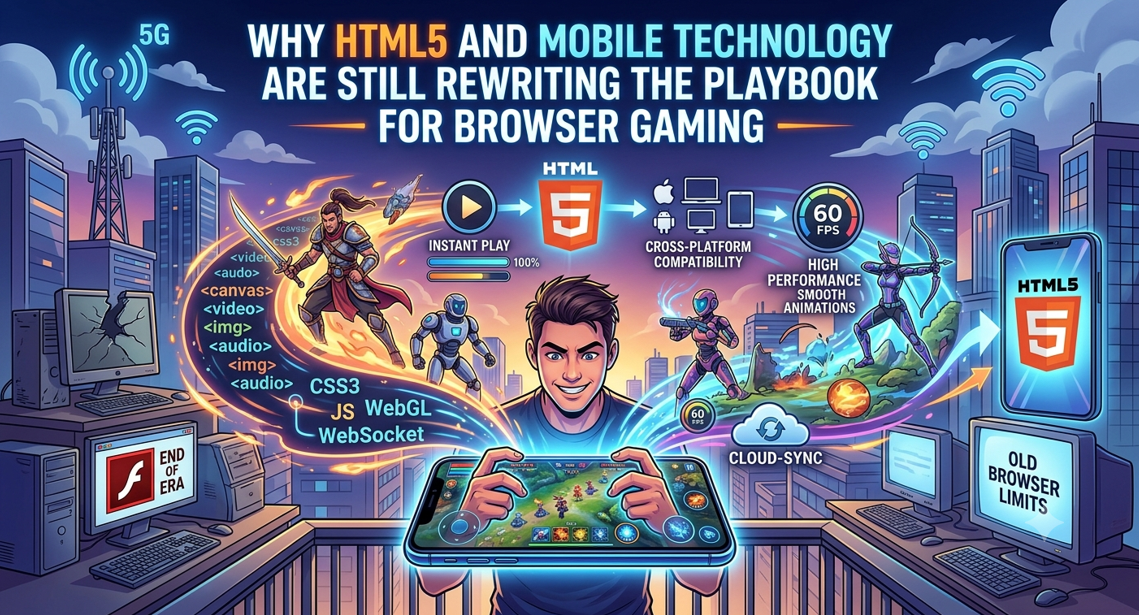
There was a time when “browser game” meant something small. A Flash-based puzzle, maybe a simple platformer, the kind of thing you played for five minutes while waiting for a file to download. That era is long gone, and most players barely remember it existed.
Browser gaming today looks almost nothing like its early ancestors. Responsive gameplay, detailed graphics, cloud saves that follow you across devices- none of this was realistic fifteen years ago. What changed wasn’t just design ambition. It was the technology underneath the whole industry.
Two forces did most of the heavy lifting: HTML5 and the relentless rise of mobile computing. Together, they didn’t just improve browser gaming. They rebuilt it from the foundation up, and the ripple effects are still spreading through the wider entertainment industry.
The Death of Plugins Changed Everything
For years, browser gaming depended on plugin technology that most users tolerated rather than enjoyed. Anyone who remembers waiting for Flash to load, or dealing with a crash mid-session, understands why its retirement felt overdue rather than disruptive.
HTML5 arrived as a standardized alternative capable of handling advanced graphics, multimedia, and real-time interaction without forcing anyone to install extra software. That single shift solved a problem developers had wrestled with for years.
Suddenly, a game could run on a desktop browser, a tablet, and a smartphone using one shared codebase. Development complexity dropped. Compatibility improved. Nobody had to explain to a frustrated user why the game wouldn’t load because of an outdated plugin.
Players noticed the difference immediately, even if most couldn’t explain exactly what had changed. Games simply loaded faster, worked more reliably, and behaved consistently no matter what device happened to be running them.
Mobile Devices Took Over the Driver’s Seat
It’s easy to underestimate how completely mobile devices have reshaped player expectations. Gaming used to be something you scheduled around, a session at a desktop after dinner, maybe a weekend afternoon. Now it fits into the gaps of a normal day.
- A ten-minute wait for a train
- A lunch break at work
- The last twenty minutes before falling asleep
None of these moments existed as gaming opportunities a decade ago. Now they’re some of the most valuable minutes in a player’s day, and developers have built entire design philosophies around capturing them.
That shift forced a rethink of priorities. Responsive layouts, touch-friendly controls, and interfaces that adapt to whatever screen they’re displayed on stopped being optional extras. They became the baseline expectation for any browser game hoping to compete.
Designing for the Palm of a Hand
Touch controls in particular demanded a complete redesign philosophy, not a simple port of existing mouse-and-keyboard mechanics. A control scheme that feels intuitive with a mouse can feel clumsy and frustrating on a five-inch touchscreen.
Studios that got this right treated mobile as the primary design target rather than an afterthought bolted on after the desktop version shipped. That distinction, small as it sounds, tends to separate the games players stick with from the ones they abandon after a session or two.
Cross-Platform Continuity Is the New Baseline
Modern players rarely commit to a single device for an entire gaming session. Someone might start a match on a desktop before finishing it on a phone during a commute home, and they expect that transition to feel invisible.
HTML5 makes this kind of continuity realistic by letting developers build applications that behave consistently across environments rather than maintaining separate codebases for each platform. Cloud synchronization handles the rest, quietly preserving preferences, progress, and settings no matter which screen a player picks up next.
For studios, this consolidation is a genuine business advantage. Building and maintaining one unified platform costs far less than juggling multiple native versions, and it frees up resources that would otherwise go toward duplicate engineering work.
Performance Has Turned Into the Real Competitive Battle
As browser games have grown more ambitious, performance optimization has quietly become one of the industry’s defining priorities. Loading times, memory consumption, frame rates, network stability- these details used to be background concerns. Now they’re front and center.
Mobile users feel this most acutely. Battery drain and inconsistent network conditions can ruin an otherwise well-designed game faster than any content decision. Developers have responded by squeezing every inefficiency out of their code, often relying on advances in browser rendering engines and JavaScript optimization to keep experiences smooth without demanding flagship hardware.
The payoff is a wider range of devices capable of running genuinely sophisticated games, which matters enormously in markets where budget smartphones still make up the bulk of the installed base.
Accessibility Is Both a Technical Win and a Business Strategy
One of HTML5’s most underrated strengths is how little friction it puts between a player and their first session. No installation process, no storage anxiety, no compatibility checks. Open a browser, and you’re playing within seconds.
That convenience matters more in some regions than others. Storage limitations and hardware diversity have historically kept certain markets on the sidelines of high-quality gaming experiences. Removing those barriers hasn’t just expanded audiences. It’s turned accessibility into a genuine competitive advantage rather than a nice-to-have feature.
Developers increasingly design with that reality in mind, building experiences that hold up on affordable devices just as well as premium ones. It’s a quieter kind of innovation, but arguably a more consequential one than flashier graphical upgrades.
A Wider Range of Experiences Than People Expect
Mention “browser gaming” and a lot of people still picture something casual and low stakes. That impression hasn’t kept pace with reality. Strategy titles, multiplayer arenas, educational simulations, and interactive storytelling experiences all now run comfortably in a browser window.
The growing popularity of gaming-related searches has also introduced localized expressions such as link gacor, reflecting the unique language that develops within online player communities. These platforms have embraced HTML5 development just as thoroughly as any other genre, delivering responsive interfaces, sharper graphics, and consistent performance across desktop and mobile browsers without leaning on outdated plugin technology. It’s a useful reminder that the underlying technology shift touched nearly every corner of digital entertainment, not just the genres that get the most attention.
Browser and App Experiences Are Learning to Coexist
Browser access remains the most frictionless entry point into most games, but plenty of developers still offer dedicated mobile applications for players who want something more integrated. These apps typically layer in cloud synchronization, push notifications, and tighter resource management, while staying linked to the same browser-based account.
That hybrid approach gives players real choice without breaking continuity between platforms. The growing availability of a dedicated APK slot download alongside browser access is a good example of this pattern, letting users pick whichever entry point suits their device and habits without losing their progress in the process. Among Indonesian gaming communities, the phrase situs gacor has become a widely recognized search term used to discuss player experiences, trending titles, and community recommendations across various digital platforms.
Community and Monetization Are Evolving Together
Player expectations have shifted beyond pure gameplay mechanics. Social features, leaderboards, and shared progress systems now play a real role in retention, often more than raw content volume does. People come back because there’s a reason to, not just because the game itself is polished.
Monetization has followed a similar arc. Subscription tiers, cosmetic upgrades, and value-added services have gradually replaced blunter, one-time payment models. Studios that treat players as long-term participants rather than single transactions tend to build more sustainable businesses, and retention data consistently backs that approach up.
Where Browser Gaming Goes From Here
The next phase of this evolution will likely lean even harder into seamlessness. Artificial intelligence is already starting to personalize recommendations and adjust difficulty on the fly. Cloud infrastructure continues to erode the gap between budget and premium hardware. Faster mobile networks are making real-time multiplayer feel less like a compromise and more like the standard experience.
HTML5 isn’t going anywhere either. If anything, it remains the connective tissue holding all of this together, giving developers a scalable, efficient foundation that works whether someone’s playing on a five-year-old phone or a brand new laptop.
None of this suggests browser gaming is trying to replace native applications. It’s doing something more interesting: complementing them, offering players more entry points into the same high-quality experiences rather than forcing a choice between them.
The Bigger Picture
HTML5 and mobile technology together have done more than modernize browser gaming. They’ve removed the friction that used to separate casual curiosity from committed play, and they’ve made “good enough” performance the norm rather than the exception across a huge range of devices.
For developers, that means simpler production pipelines and larger addressable audiences. For players, it means fewer barriers between wanting to play something and actually playing it. As browser standards keep evolving alongside mobile hardware and cloud computing, the next generation of browser gaming won’t be defined by what platforms can’t do. It will be defined by how invisible those old limitations have become.
