

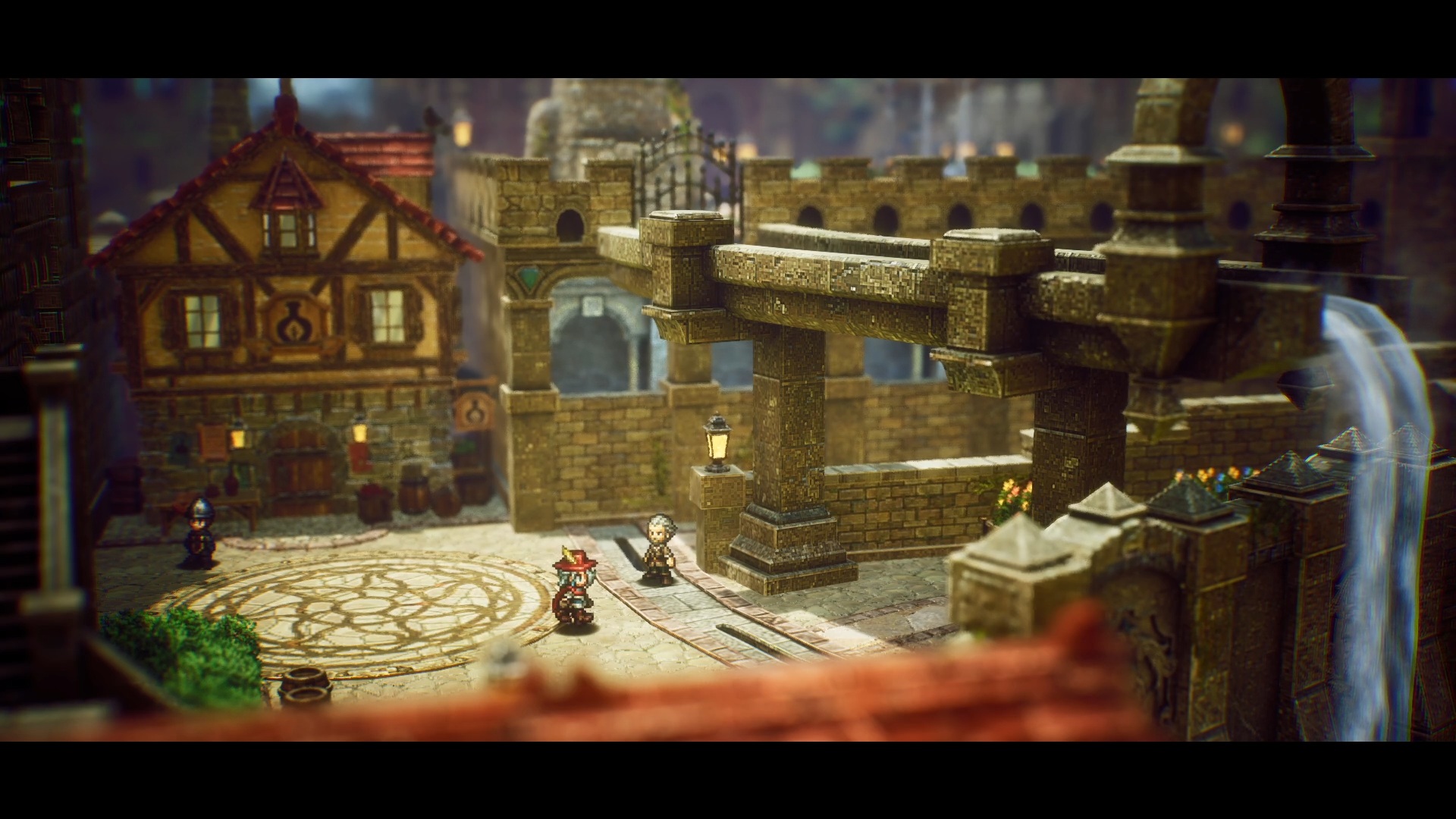
To this point, the tandem of publisher Square Enix and developer Team Asano have put out a handful of memorable turn-based RPG and strategy titles. They’ve told fantastical tales across the Octopath Traveler series, Bravely Default series, and games like Triangle Strategy. With The Adventures of Elliot: The Millennium Tales, the time for taking turns is over. For Team Asano, as well as developer Claytechworks, this represents a different kind of HD-2D adventure, one that harkens back to games like The Legend of Zelda: A Link to the Past and another classic Square Enix gem, Secret of Mana. The result is a captivating tale of heroism, albeit one that does have a few quirks.
Tale as old as time
Source: Square Enix
The Adventures of Elliot opens with the noble King Hichard learning of a set of ruins discovered in the world, square in the middle of hostile beast tribe territory. The power-hungry Minister Kaifried wants to take soldiers to investigate, but the king is soon convinced to hire an adventurer to scope the ruins out first. That adventurer is Elliot, who is basically a hero for hire who goes on adventures for service, thrills, and coins for the kingdom’s orphanage.
Princess Heuria takes a liking to Elliot and offers to keep in touch using her magical powers. Her magic proficiency is the highest in the kingdom, allowing her to use a spell of Safekeeping to keep it safe from invading Beastmen. After exploring the ruins, a powerful weapon is discovered within, and it draws Minister Kaifried to seize it. Kaifried taking the weapon has a ripple effect across the ages and, among its consequences, leaves Heuria (and, consequently, the spell of Safekeeping) weakened.
To get to the bottom of how to save Heuria and the kingdom, Elliot begins discovering different Doorways of Time, which take him across three other time periods. He meets various characters, many of whom have a profound influence on the world’s present, past, and future, but the most crucial character he meets is a fairy named Faie. One might read all of this and reasonably assume that Kaifried is the game’s central villain and that’s not necessarily the case, but that’s part of the allure of Elliot’s story, which I’ll get into shortly.
Tools of the adventuring trade
Source: Square Enix
The Adventures of Elliot plays like a standard action-RPG. The title character starts off with his sword and shield, only occasionally finding upgrades for the former inside treasure chests scattered across the world and inside dungeons. Elliot also has a few secondary weapons he carries around, like a boomerang, bombs, a spear, a giant hammer, and others. Enemies get tougher as the game goes along, but Elliot himself does not level up. Instead, he’ll find higher-quality weapons, but he can also bolster them further with a resource called Magicite.
The Magicite system is one of those ideas that should feel simple, but it can sometimes feel needlessly complex. Magicite gems will offer stat buffs, secondary abilities, and other boosts, sometimes with a tradeoff. Those gems also come with a number value, so determining which ones can be equipped for which weapon at a time can sometimes turn into a math quiz. It doesn’t help that the Magicite gems are presented through an inelegant text list, so you’re left scrolling up and down and racking your brain over what to equip.
Add in that you’ll be doing this for every one of Elliot’s weapons and the whole thing turns into a tedious exercise. As cumbersome as managing a skill or talent tree often is, the layout is usually much cleaner than what’s presented here. I understand the desire to distance this game from Team Asano’s turn-based RPGs and their level-based progression system, but I would have rather traded in the time I spent managing Magicite for a simpler character-based skill tree. It also would have given me more incentive to fight enemies, because I was using Faie’s Sprint skill to actively avoid them by the end.
Source: Square Enix
Speaking of Faie’s skills, that’s one area where The Adventures of Elliot shines. Faie isn’t presented as a passive character. She can learn skills like Ignite, to light up enemies; Warp, to transport Elliot to distant places; and Copy, to create an active Elliot clone, all of which make her an active participant on this journey. She’s so active, in fact, that it’s possible to assign a second player to her slot. Without a second player in place, she’s controlled by the right thumbstick, giving an extra layer to combat and traversal. There were more than a few instances where I was able to outlast a boss by letting Faie’s Ignite burning damage kick in for just a few more seconds.
Faie’s usefulness in the battlefield almost offsets what an active annoyance she is during the rest of the game. I had a bad feeling about Faie during my preview back in May. I regret to note that she’s still extremely talkative and nearly everything she offers is either a banal observation or an unnecessary “Captain Obvious” comment. I tried to make it through the full game without going to the Options menu to turn down her talkativeness, but I ultimately gave in at the halfway point. Imagine my surprise when that setting barely had any effect.
Hero of time
Source: Square Enix
The Adventures of Elliot’s other key feature involves moving across four different time periods to progress the story. It starts to become fascinating to explore the world in the original Age of Safekeeping, only to see the same overworld layouts for the other three time periods. That’s because there are enough minor differences to keep you interested, but there isn’t anything so different that you won’t know where you’re going. There were a few instances where I felt lost, but studying the overworld maps and zooming in eventually had me on my way.
It was also fascinating to see how the time changes affected dungeon layouts. Only one age will allow players to reach a dungeon’s boss and endpoint, while the others are either too old and undeveloped or too dilapidated from the passage of time. Those other dungeons aren’t entirely useless, as they’ll still have some valuable treasures in them, but part of the fun for me was figuring out which age would let me see a dungeon through to its conclusion. Plus, the game’s fast travel mechanic didn’t make me feel like I had wasted too much time. Fast travel works across the overworld for all four ages simultaneously, and it also works within dungeons, allowing players to warp back to the beginning in the event that they hit a dead end.
Memorizing the map was also helpful in completing side quests. I do want to note that I’m tempted to use “side” quests in quotes, because some of them offer some invaluable accessories that come in handy. This was where I came to both love and hate this game, because the side quests were mostly satisfying endeavors that helped flesh out the game’s story and the world’s lore. The problem came at the end where the game threatened to close off several side quests for good if I proceeded with the story any further. I stopped what I was doing and went off to try and complete as many of the remaining side quests as I could, only to stumble on a story event that kicked off the path to the good ending (Oh yeah, there are good and bad endings, so make a note of that) and inadvertently closed off my remaining side quests. I had to boot up a previous save file to reopen them.
To bring this section full circle, I want to touch on the map and this world filled with unlockables and treasures from across the ages. That’s great and all, but the game doesn’t always make it easy to find certain field skills. There was one instance where I was in a late dungeon in pursuit of the good ending, only to find something locked behind a field skill that I hadn’t learned yet. I only know this because Faie said something like, “We haven’t learned this skill yet.” Well, she told me we hadn’t learned it, but neither she nor the game gave me any idea of what the skill was or how to unlock it. So I ultimately skipped it and wound up with the bad ending, hoping to go back to it later with a clearer head. The Adventures of Elliot doesn’t have many obtuse moments like this, but when it does, it’s brutal.
Adventure awaits
There’s a lot that I enjoyed about The Adventures of Elliot: The Millennium Tales. I barely even touched on the title character himself. Elliot is presented as a brave adventurer with a silver tongue, but not quippy or otherwise anachronistic. He’s exactly the kind of hero you want to see in this type of game. He’s brave, he’s likable, and he selflessly fights for the service of others. For as much as I disliked Faie, that’s how much I loved Elliot. Don’t think I didn’t notice that even as Faie got more and more annoying over the course of the story, Elliot was never short with her. He’s everything you look for in a hero and one I’ll remember for a long time.
His journey is one that’s worth experiencing, too. The combat is engaging, the dungeons are fun to explore, and for as much as I disliked the manner in which the Magicite system was presented, I did like experimenting with certain builds. Plus, unlike some of Team Asano’s previous offerings, this game doesn’t overstay its welcome. I was able to roll credits in under 15 hours, which isn’t something I was able to say about the Octopath Traveler and Bravely Default games. For anyone who loves old-school Zelda-style action games, Elliot’s story proves to be an adventure worth embarking on.
This review is based on a PC key provided by the publisher. The Adventures of Elliot: The Millennium Tales will be available on Thursday, June 18 on PC, PlayStation 5, Xbox Series X|S, and Nintendo Switch 2. The game is rated T.
Shacknews staff does not use generative artificial intelligence (AI) in their content. Shacknews strictly prohibits the use of its content for AI training or to generate text, including text in the style or format used for this publication. Shacknews reserves all rights to this work.
Ozzie has been playing video games since picking up his first NES controller at age 5. He has been into games ever since, only briefly stepping away during his college years. But he was pulled back in after spending years in QA circles for both THQ and Activision, mostly spending time helping to push forward the Guitar Hero series at its peak. Ozzie has become a big fan of platformers, puzzle games, shooters, and RPGs, just to name a few genres, but he’s also a huge sucker for anything with a good, compelling narrative behind it. Because what are video games if you can’t enjoy a good story with a fresh Cherry Coke?
